FMCG

Beyond ABC Analysis: Managing the Long Tail in an Omni-Channel World

Beyond ABC Analysis: Managing the Long Tail in an Omni-Channel World

Beyond ABC Analysis: Managing the Long Tail in an Omni-Channel World 1536 1024 qwixpertadmin

A common complaint among FMCG supply chain leaders today sounds something like this:

“Our inventory is higher than ever, warehouse space is under pressure, and yet we continue to face stock-outs on key digital channels.”

At first glance, these issues appear unrelated. However, in many organisations, they stem from the same underlying challenge: the growing long tail of SKUs created by e-commerce marketplaces, quick commerce, and Direct-to-Consumer (DTC) channels.

For decades, FMCG supply chains were built around a relatively concentrated product portfolio. General Trade (GT) and Modern Trade (MT) naturally filtered assortments. Shelf space was limited, distributors focused on fast-moving products, and planning teams could concentrate on a manageable set of high-volume SKUs.

The emergence of digital channels has changed that equation. Every flavour, pack size, variant, bundle, gift pack, regional assortment, and limited-edition product can now be listed online. Consumers expect choice, and digital platforms reward breadth of assortment. As a result, SKU counts have grown significantly across many FMCG categories.

The challenge is that while the revenue opportunity from the long tail is real, managing these SKUs using traditional planning and inventory policies can create substantial operational and financial inefficiencies.

The Problem is Not the Long Tail

Many organisations respond to growing SKU complexity by launching SKU rationalisation exercises. While rationalisation has its place, it is often an incomplete solution.

Not every low-volume SKU is a bad SKU. Some products play an important role in attracting consumers to digital platforms. Others serve niche but profitable customer segments. Certain SKUs support premium positioning, seasonal campaigns, or new product launches. Eliminating them purely because they have lower volumes may hurt growth more than it helps efficiency.

The real problem is not the existence of long-tail SKUs. The problem is managing them using the same planning, sourcing, inventory, and service policies as fast movers. In other words, the future of long-tail management is not aggressive SKU reduction. It is differentiated management.

Why Traditional ABC Analysis is No Longer Enough

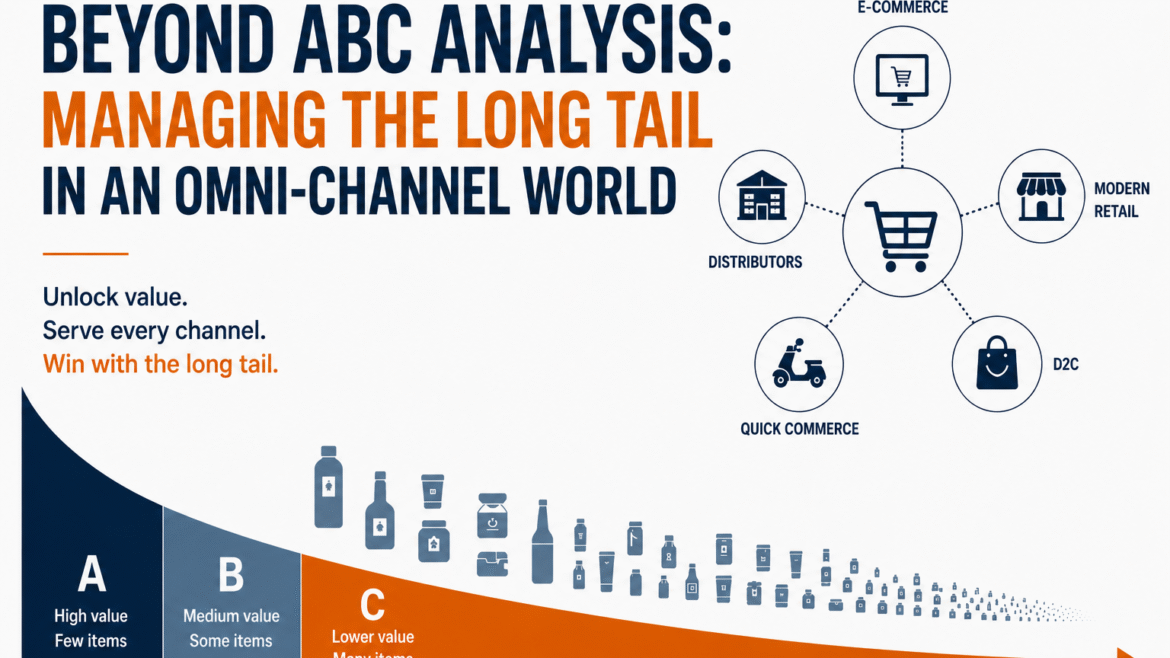
Most supply chains still rely heavily on ABC analysis: Fast movers become A-items, Medium movers become B-items, and Slow movers become C-items.

While useful, this approach was designed for a simpler world. Today’s omni-channel environment requires a richer understanding of SKU behaviour. A slow-moving SKU can still be strategically important. A seasonal product may have low annual volume but extremely high demand concentration during specific periods. A marketplace-exclusive pack may contribute little revenue but help improve search visibility and consumer acquisition. Treating all slow-moving products the same often leads to poor decisions.

Traditional ABC analysis answers only one question: How much does a SKU sell? Unfortunately, modern supply chains need to answer several additional questions. Is demand predictable? Is the SKU strategically important? Does it carry high obsolescence risk? Does it move frequently enough to justify frequent replenishment? These questions require a broader classification framework than sales volume alone.

A More Practical Framework for Long-Tail Management

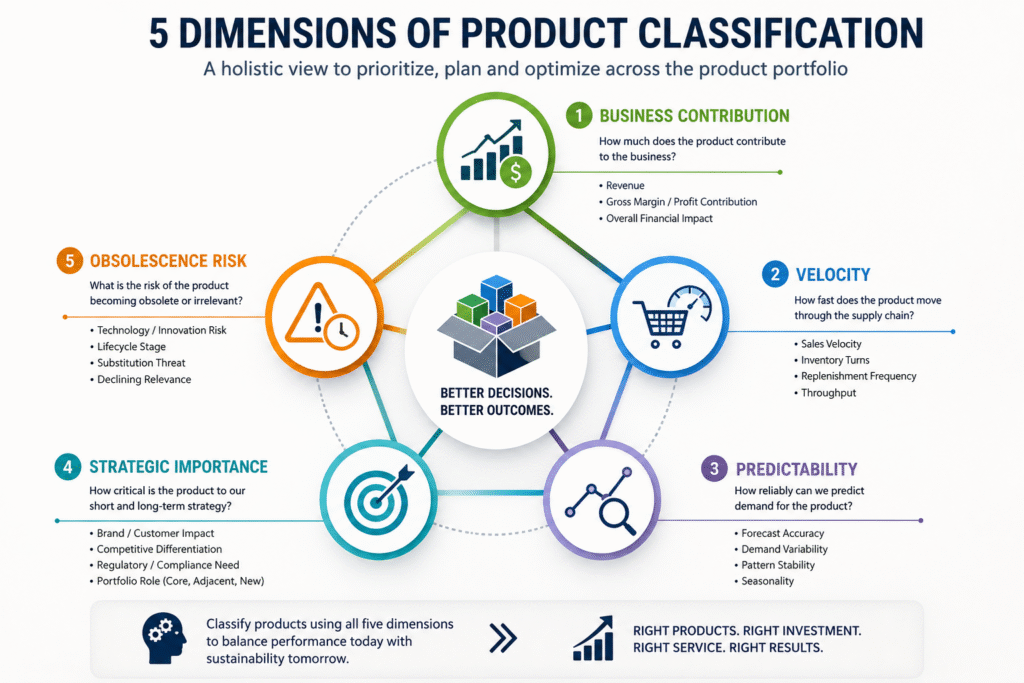
Instead of classifying products solely by volume, organisations should evaluate SKUs across five dimensions.

1. Business Contribution

How much does the SKU contribute to the revenue? This is a traditional ABC Pareto analysis, with A, B, and C category SKUs contributing 80%, 15%, and 5% of revenue, respectively. This classification helps the planner identify the SKUs that drive sales. The exact cut-off could be modified to 60-30-10 or 70-20-10 depending on the business. In some of the businesses, profit contribution is considered instead of revenue.

2. Velocity

How quickly does the SKU move? Velocity is usually measured using the frequency of the orders. Another term the industry uses is “runner,” “repeater,” or “stranger.” This remains important because velocity directly influences inventory turns, replenishment frequency, and warehouse handling requirements.

3. Predictability

How stable is demand? This is measured by the uniformity of the orders throughout the year. Some products exhibit consistent demand patterns while others are highly seasonal, promotion-driven, or event-driven. SKUs could be classified as regular, irregular, seasonal, or sporadic. Similarly, if the SKU is forecastable or non-forecastable. Two SKUs with identical annual volumes may require completely different inventory policies if their demand profiles differ.

4. Strategic Importance

What role does the SKU play in the portfolio? Certain products may be critical despite low sales volumes. Examples include premium variants, marketplace exclusives, hero products, or strategic new launches. Revenue contribution alone does not determine business importance. Often, there are flagship products that define the company’s competitive position. Sometimes, the product needs to be planned as part of portfolio completion.

5. Obsolescence Risk

How likely is inventory to become unsellable? This is particularly relevant in FMCG categories with shelf-life constraints. Low-velocity products with short shelf life require very different planning policies than low-velocity products with long shelf life.

These five dimensions create a more meaningful basis for segmentation and decision-making than traditional ABC analysis alone.
The Hidden Cost of Long-Tail SKUs 

One of the most common mistakes organisations make is focusing exclusively on procurement economics. 

Procurement teams often seek larger purchase quantities to improve unit costs, secure volume discounts, or optimise freight economics. While this may reduce purchase costs, it can significantly increase inventory carrying costs, obsolescence risk, warehouse complexity, and working capital requirements. 

In many situations, the cheapest procurement decision becomes the most expensive inventory decision. In many situations, the cheapest procurement decision becomes the most expensive inventory decision.

Purchasing six or twelve months of inventory may appear attractive from a sourcing perspective. However, the resulting inventory exposure can lead to write-offs, liquidation discounts, excess warehouse occupancy, and capital locked in stock that may never be sold. 

Every additional long-tail SKU also consumes planning bandwidth through forecasting, exception management, parameter maintenance and master data administration. 
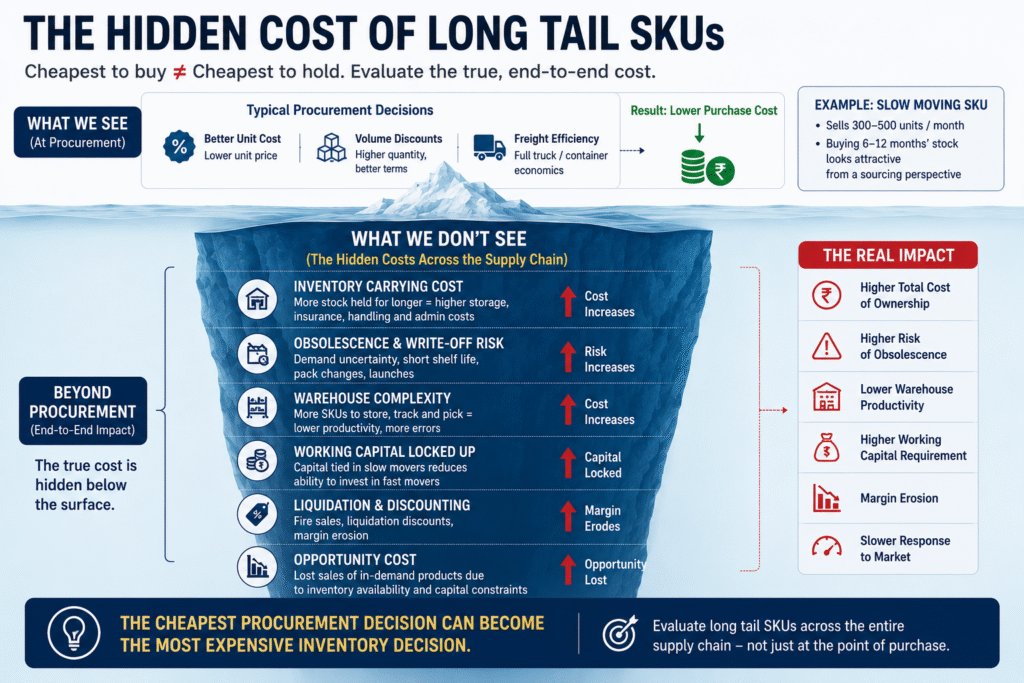

The economics of long-tail products must therefore be evaluated across the entire supply chain rather than within procurement alone.

Different SKUs Require Different Service Levels

Another common practice is applying similar service targets across the portfolio. Many organisations target 95% availability for virtually all products. While appropriate for core fast-moving products, this approach often creates unnecessary inventory investment for long-tail items.

Service levels should not be determined by sales volume alone. They should reflect the product’s business contribution, lifecycle stage, strategic importance and channel role.

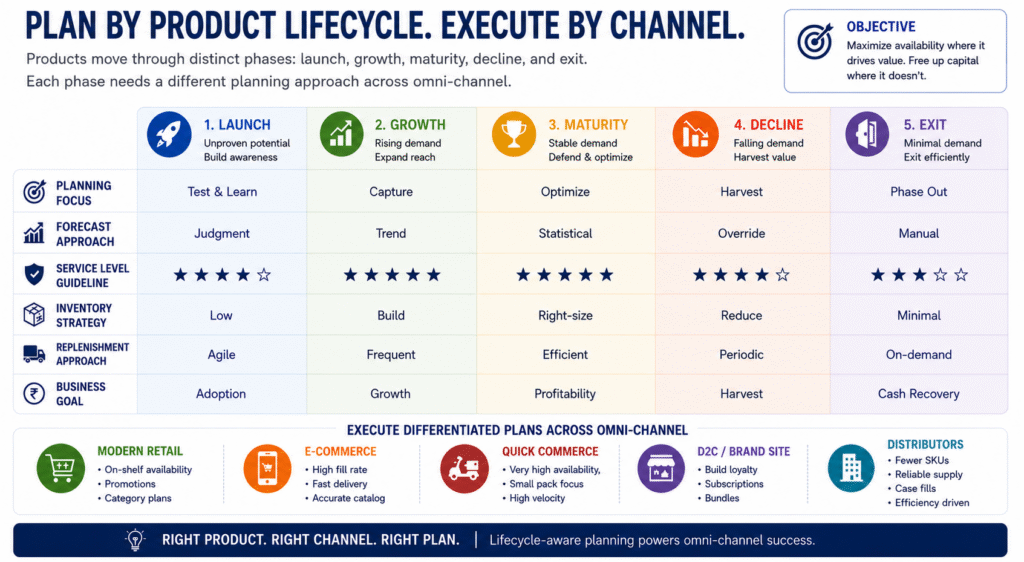
A more effective approach is differentiated service management. Core products may warrant service levels above 90-95%. Growth products may require 95–98%. Strategic niche products may operate at slightly lower levels. Low-priority long-tail products may justify even more selective inventory policies. The product on exit will not even have service level targets and probably will have as low as 30-50% service levels. The objective is not to reduce service indiscriminately. It is to align service expectations with business value.

Lifecycle Management Matters

Perhaps the most overlooked aspect of long-tail management is lifecycle tracking. Products move through distinct phases: launch, growth, maturity, decline, and exit. Yet many organizations continue using the same planning parameters throughout the product’s life.

As products mature and demand patterns change, inventory policies, service levels, replenishment frequencies, and sourcing strategies should evolve accordingly. Lifecycle-driven planning helps organizations reduce obsolescence risk while maintaining availability where it matters most.

Lifecycle transitions should automatically trigger changes in planning parameters rather than relying on manual planner intervention.
What We Commonly Observe 

Across consumer goods, food and beverage, personal care, retail, fashion, and consumer durables sectors, a recurring pattern emerges. Although the exact numbers vary, we frequently observe that roughly 20–25% of SKUs generate most of the revenue, while the remaining long tail drives a disproportionate share of inventory, planning effort and warehouse complexity. 

However, the answer is rarely wholesale rationalisation. Organisations that achieve the best results are those that develop differentiated policies for different SKU segments balancing availability, working capital, service, and profitability according to the characteristics of each product. 

Conclusion 

The growth of e-commerce, quick commerce, and DTC channels has made the long tail a permanent feature of the modern FMCG landscape. Consumers expect choice, and digital platforms reward breadth of assortment. The question is no longer whether organisations should carry long-tail SKUs. The question is how intelligently they manage them. 

The future belongs to companies that move beyond traditional ABC analysis and adopt differentiated approaches to inventory, sourcing, service levels, and lifecycle management. Competitive advantage in an omni-channel world will not come from carrying fewer SKUs. It will come from understanding which SKUs deserve different supply chain policies—and having the discipline to execute them consistently. 

About the Authors

Qwixpert is a boutique management consulting firm focused on building Future-Fit Supply Chains. The firm works with organisations across consumer goods, retail, fashion, industrial products, and aftermarket sectors to improve agility, inventory productivity, fulfilment performance, and supply chain decision-making.

Through more than 100 consulting engagements across 16 industries, the team has observed how digital channels, changing consumer behaviour, and rising service expectations are redefining the role of supply chains.

This article is part of a broader series exploring the implications of these shifts in trade channels and the capabilities organisations need to build for the future.
FMCG Supply Chains and the Rise of New-Age Sales Channels

FMCG Supply Chains and the Rise of New-Age Sales Channels

FMCG Supply Chains and the Rise of New-Age Sales Channels 1920 1080 qwixpertadmin

A Supply Chain Head of an FMCG company recently shared three seemingly unrelated concerns. Inventory levels were at a record high, yet key SKUs continued to go out of stock on quick commerce platforms. Marketplace sales were growing rapidly, but fulfilment costs and returns were eroding margins faster than anticipated. Meanwhile, warehouse teams that had successfully supported General Trade and Modern Trade for years were struggling to cope with the growing volume of small, fragmented orders from e-commerce and DTC channels.

If these challenges sound familiar, you are not alone.

For decades, FMCG supply chains were designed around a relatively predictable operating model. Products moved from factories to warehouses, distributors, retailers, and finally consumers. Success depended on manufacturing efficiency, distribution reach, inventory availability, and cost control. General Trade (GT) and, later, Modern Trade (MT) became the backbone of this model, enabling companies to scale through standardised planning and replenishment processes. That world is rapidly changing.

The rise of e-commerce marketplaces, quick commerce, B2B e-commerce platforms, and Direct-to-Consumer (DTC) channels has fundamentally altered how products are sold, fulfilled, and replenished. While these channels have opened new avenues for growth, they have also introduced a level of supply chain complexity that many FMCG organisations are struggling to manage.

The challenge is no longer about moving large quantities of products efficiently. It is about fulfilling thousands of fragmented demand signals accurately, quickly, and profitably across an increasingly complex channel ecosystem.

Why New-Age Channels Are Different

Traditional GT and MT channels operate on aggregated demand. Orders are typically placed in case quantities, replenishment cycles are predictable, and distributors often absorb inventory and demand variability.

New-age channels operate very differently. Demand is visible in real time, service failures are immediately measured, and supply chain performance directly impacts sales visibility. A stock-out on a marketplace listing can reduce search rankings. A missed replenishment to a quick commerce dark store can result in lost sales within hours. A delayed DTC order can negatively affect customer ratings and repeat purchases.

In effect, FMCG supply chains are evolving from bulk logistics networks to precision fulfilment networks.

The Emerging Supply Chain Challenges

Inventory Fragmentation

One of the most significant challenges is inventory fragmentation. Inventory is no longer concentrated within plants, depots, and distributor networks. It is spread across marketplace fulfilment centres, quick commerce partner distribution centres, dark stores, DTC warehouses, and traditional trade channels.

This creates multiple inventory pools with limited visibility across the network. Many companies simultaneously experience excess inventory in one channel and stock-outs in another, resulting in higher working capital and lower service levels.

Long Catalogue Complexity

Digital channels encourage broader assortments, channel-exclusive packs, bundles, premium variants, and regional offerings. While this improves consumer choice, it significantly increases forecasting complexity. Slow-moving and long-tail SKUs consume working capital, create warehouse inefficiencies, and increase obsolescence risk. Managing thousands of digital SKUs requires a very different planning capability compared to managing a focused GT portfolio.

Warehouse Operations Designed for the Wrong World

Most FMCG warehouses were built for pallet and case movement. New-age channels demand piece picking, kitting, bundling, labelling, and high order accuracy. Quick commerce further increases complexity through high-frequency replenishment cycles and smaller order quantities. Warehouses must now balance throughput with flexibility, speed, and accuracy.

Appointment Management and Compliance

Marketplace fulfilment centres and quick commerce distribution hubs operate through tightly controlled appointment systems. Missing a delivery slot can delay inventory availability by days or even weeks. In addition, channel-specific requirements around labelling, packaging, barcoding, and documentation create operational complexity that did not exist in traditional trade models.

Returns and Reverse Logistics

Returns were historically limited within FMCG supply chains. Digital channels have changed this reality. Consumer returns, rejected deliveries, expiry returns, and damaged shipments have become meaningful cost drivers. Reverse logistics processes often lack visibility, creating additional write-offs and operational effort.

OTIF as a Commercial Lever

On-Time-In-Full (OTIF) performance has moved beyond an operational metric. It has become a commercial requirement. Poor service levels can result in penalties, listing suppression, reduced visibility, chargebacks, and even SKU delisting. Unlike traditional trade, where relationships often provide flexibility, digital platforms operate through automated scorecards and service-level agreements.

How Mature Is Your Omni-Channel Supply Chain?

The shift in channel mix is forcing organisations to rethink the very purpose of supply chain management. Historically, the channels have evolved as given below:

EraDominant Business ModelSupply Chain Objective
1990–2010General TradeReach and Availability
2010–2020Modern TradeAvailability and Efficiency
2020–PresentOmni-ChannelAvailability, Speed and Accuracy
EmergingQuick Commerce & DTCAvailability, Speed, Accuracy and Agility

As channels evolve, supply chains must evolve with them. Organisations that continue to manage digital channels using GT-era processes will increasingly struggle with service levels, inventory productivity, and profitability.

Qwixpert has classified the supply chain maturity of the FMCG industry from level 1 to level 5 as follows:

LevelCharacteristicsTypical Symptoms
Level 1:
Channel-Specific Operations
GT, MT, E-commerce and Q-Commerce managed independentlyInventory duplication, firefighting, frequent stock-outs
Level 2:
Coordinated Planning
Shared forecasting and periodic inventory reviewsImproved visibility but still reactive
Level 3:
Integrated Fulfilment Network
Common inventory view, channel allocation rules, standard OTIF governanceBetter service and lower working capital
Level 4:
Demand-Driven Supply Chain
Near real-time replenishment, dynamic inventory balancing, demand sensingFaster response to channel volatility
Level 5:
Demand Driven Enterprise
Promise dates driven by inventory, capacity, constraints and service prioritiesCompetitive advantage through service, speed and working capital efficiency

Many companies are still in the early stages of this transformation.

The most successful organisations are increasingly moving beyond inventory planning toward integrated decision-making across inventory, capacity, fulfilment, and customer service. The most advanced Demand-Driven Enterprises are increasingly adopting Available-to-Promise (ATP) and Capable-to-Promise (CTP) capabilities to make inventory and capacity commitments dynamically across channels.

What We Commonly Observe

Across consumer goods, food and beverages, personal care, fashion, consumer durables, retail, and aftermarket supply chains, several recurring themes emerge. GT-centric planning continues to dominate despite rapid growth in digital channels. Inventory visibility remains fragmented across multiple nodes. Warehouses struggle to support unit-level fulfilment. OTIF measurement differs across channels. Most importantly, organisations often lack a clear understanding of the true cost-to-serve each channel. These challenges are not operational exceptions—they are becoming structural realities of the modern FMCG landscape.

Conclusion

The next decade of FMCG supply chains will not be won by organisations that simply move the most inventory. It will be won by those who can orchestrate inventory, fulfilment, capacity, and service seamlessly across an increasingly fragmented channel ecosystem.

As new-age channels continue to grow, supply chain excellence will increasingly be defined not by scale alone, but by the ability to balance availability, speed, accuracy, agility, and profitability simultaneously.

About the Authors

Qwixpert is a boutique management consulting firm focused on supply chain and operations transformation. The team has worked across FMCG, food and beverages, personal care, retail, fashion, consumer durables, automotive aftermarket, industrial products, and e-commerce sectors, helping organisations improve planning, inventory, warehousing, logistics, network design, and fulfilment performance.

Through engagements spanning traditional trade, modern trade, e-commerce marketplaces, quick commerce, DTC, and B2B channels, the team has observed first-hand how channel evolution is reshaping supply chain operating models and creating new demands on planning, inventory, warehousing, and service execution.

How would FMCG distribution of the future look like?

How would FMCG distribution of the future look like? 781 527 qwixpertadmin

Executive Summary

Emerging Tech based B2B models are disrupting the traditional distribution space. Unlike the traditional distribution model which has only one source of revenue i.e., via trade of products, the new age tech-driven businesses can generate income from advertisements, data analytics, private label sales, financial and PoS services. These allow online platforms to pass higher product margins to retailers. FMCG Distributors must offer additional value and create differentiated offerings to retailers to level the playing field. Consolidation in distributor territories will be actively pursued by FMCG brands. Multi-brand master distributors akin to those in consumer electronics and global auto sales are expected to emerge. Partnerships with financial institutions, PoS solutions providers and distributed warehousing for faster replenishment. Additionally private labels and backward integration into 3PL and warehousing services can add to distributors ability to compete.

Emerging Business models in B2B Distribution landscape

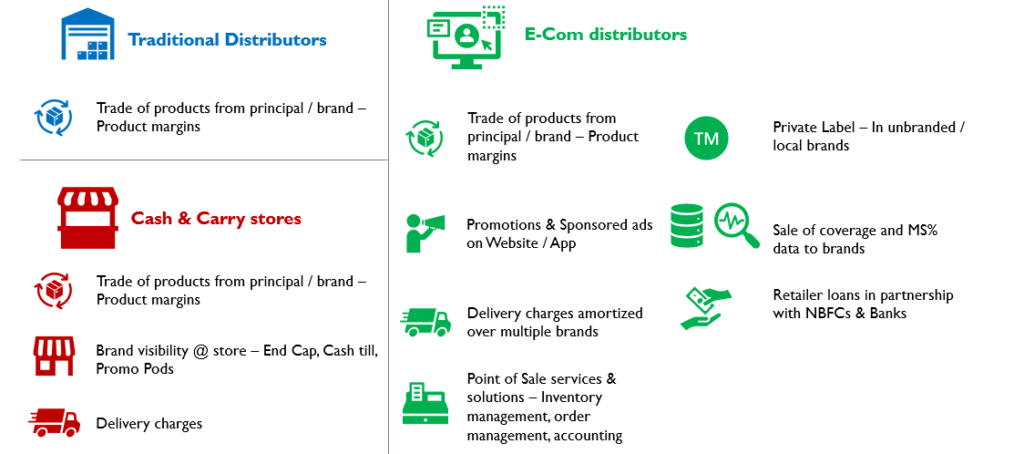
Initially FMCG downstream supply chain had a “distributed” channel structure. Traditional distributors covered towns or part of towns and were mostly exclusive to a particular brand, built relationships with the many thousand general trade outlets and wholesalers operating locally. Retailers in a town depended on these distributors to deliver orders or visited wholesalers to pick up required stock. This traditional distributor managed demand and working capital efficiently doling out micro-credit and also drove trade marketing initiatives for the brands. This model was first disrupted by the brand aggregators – Modern Trade Wholesalers like Metro, Booker and Walmart. These MT outlets offered a one stop-shop for retailers across brands and categories, but did not offer door-step delivery unlike the traditional distributors. The informal credit practice was also not extended. Prohibitive freight costs in low volume towns meant direct coverage was ~50 – 60% for even the biggest of FMCG brands. Online platform led distribution wishes to offer the best of both worlds – aggregated demand to be a one-stop shop for the retailer, amortizing freight costs to ensure direct distribution with door-step delivery and offer micro-credit with partnerships.

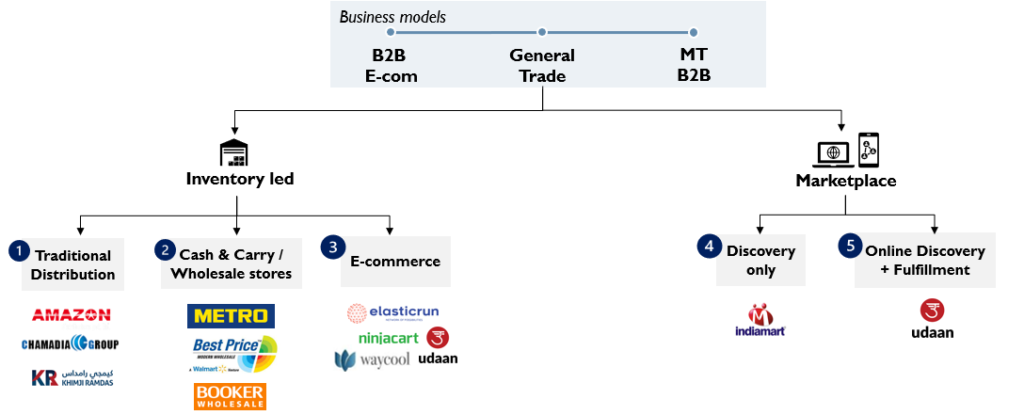
Fig 1: Comparison of different business models in FMCG B2B distribution

The traditional distributor and the cash & carry wholesaler-built businesses on an inventory led model, where stock is purchased from FMCG brands to be resold. Working capital management becomes critical with low profit margins and large revenues. Success depended on the business owner’s ability to rotate capital as many times as possible. Marketplace platforms, avoiding taking inventory onto their books by creating a platform for buyers & sellers to engage directly. They may or may not undertake order fulfilment creating two business models – Discovery only and Discovery and fulfilment.

Each of these Business models have different sources of revenue

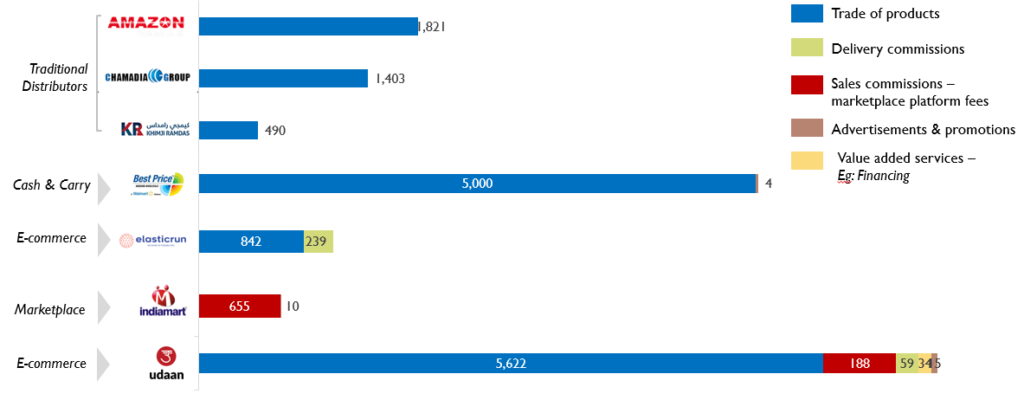
Analysis of each business highlights the various revenue models in play. A traditional distributor generates revenues on the wholesale trade of products and manages all costs of operations within the margins offered by the principal brand(s). Cash & carry stores can additionally generate promotional income from brand visibility – on shelves, cash tills, end-caps and in-store promoters. In the recent past, cash & carry wholesalers have built websites and mobile applications to allow retailers the convenience to order online and get deliveries for an extra charge.

Fig 2: Comparison of operating revenue streams in FMCG B2B distribution – FY21

E-Commerce platforms using the inventory or the marketplace model generate promotional income from brands through brand pages, search based advertisements and sponsored listings. Organizations like Udaan, Elastic Run are additionally offering micro-credit to fund for the retailers’ working capital.

Profitability built on lean and efficient operations in inventory models 

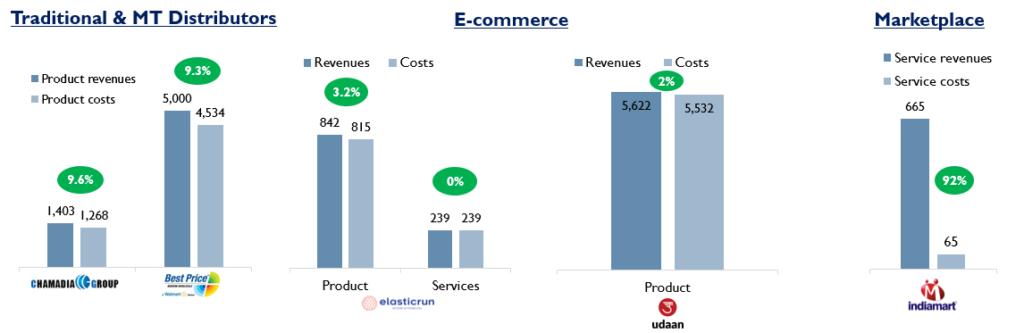
Fig 3: Comparison of operating revenues, costs and margins across business models – FY21

The traditional distribution system operates on a gross margin of ~8 – 12%, for mass market products. These wafer thin margins, drive the distributor ecosystems to have lean and efficient operations. Low inventory levels with “Fast moving” stock characterises the inventory model and hence offers the name to the industry – “Fast Moving Consumer Goods”. Manpower productivity and optimized freight costs are critical to profitability and so is effective credit cycle and cash flow management. Companies operate with 15 – 20 days of stock and ~20 – 30 days of payable and receivable days. This working capital is usually the investment made by the distributor and if these benchmarks are maintained, the distributor can expect an RoCE of ~30%. Qwixpert’s analysis indicates the median RoCE of the top distributors of the country is ~33% and they operate at 21 days of inventory, 20 days of sales outstanding and 15 days of payables outstanding.

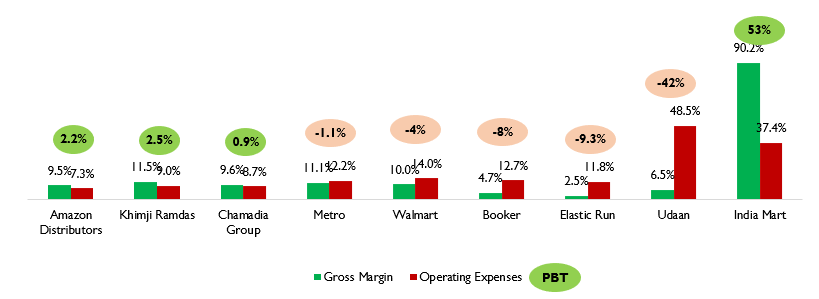
The contrasts can be noted in Indiamart’s marketplace model, where the gross margins are at ~90%. The marketplace platform charges fees on the discovery and engagement between buyers and sellers, while IT & employee costs borne to manage engagement & discovery are the primary cost of services.

Assessment of cost drivers indicate the need for lean business operations to drive profitability

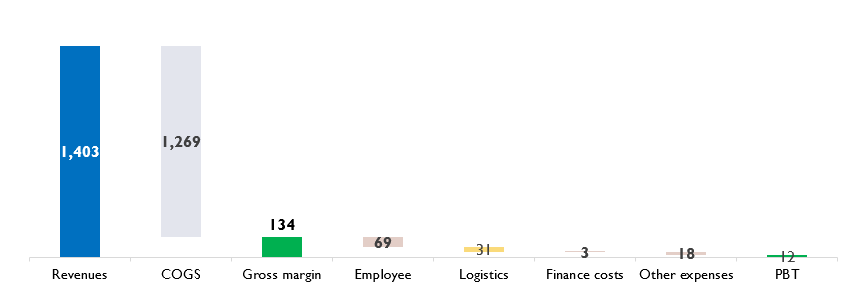
The traditional distributor is not too worried about revenues. The margin and the “fast moving” nature of the merchandise are more critical factors in deciding the SKUs to stock and volumes to purchase. Higher the premiumness of the merchandise, higher the gross margins. To drive profitability, the distributor from hereon, effectively utilizes assets – warehousing infrastructure, logistics network, inventories, sales & distribution manpower. Four key metrics – SKU throughput, freight cost per unit, manpower productivity and inventory days – are measured and optimized for religiously. An analysis of one of P&G’s largest distributors – Chamadia Group (Fig 4) – indicates how razor thin profit margins look when compared with product revenues. But, a comparison with the gross margins indicates a reasonable 9% profitability before tax.

Fig 4: Chamadia Group – Profitability waterfall – FY21

The modern trade wholesalers are yet to make profits and the likes of Walmart benefit at a group level from the Indian office, by sourcing private label manufacturers for their global businesses. Negative bottom lines are also a reflection of the operating costs not being lean, as seen in Fig 5 – This can be noticed from the similar gross margins to traditional distributors but much higher operating costs. The online distributors – Elastic Run, Udaan – have much thinner gross margins, indicating their aggressive pricing to capture the market. Udaan’s overheads are significantly higher and need to be drastically optimized or monetized for profitability. Elastic Run’s operating costs are in line with traditional businesses, indicating a much tighter business.

Fig 5: Profit margins as a % of revenue – B2B distribution businesses – FY21

There are primarily 2 ways by which firms can increase their profitability in B2B distribution landscape i.e., Optimizing the cost-to-serve or by increasing the product margins.

In the Traditional Distribution business, cost-to-serve is optimized by enhanced productivity of manpower and/or investing in supply chain automation – warehousing to achieve a trade off between throughput, storage density and labour expenses & logistics – inhouse vs 3PL, route & fleet optimizations. Increasing the mix and throughput of premium merchandise (higher margin products) in sales can increase profitability. Upgrading the customers to higher margin products is a function of consumer economic growth and brand marketing. The E-commerce distribution model, on the contrary, offers new income streams compensating for the higher margin passed on to the retailer.

E-Commerce businesses bet on new revenue streams to overcome higher costs

Traditional distributors begin to extend their businesses into the premium range, with non-competing brands or in non-competing geographies to increase bottom-lines. Chamadia Group, for instance, has a separate business focused on distribution of imported & premium products. Higher margins are also present in selling unbranded and locally manufactured products – Eg: Grains, pulses, local snacks and by venturing into Private labels. Existing retail coverage and the understanding of the General Trade market are key USPs which traditional distributors can leverage to succeed in private label businesses.

The Cash & carry players offer Product placement / positioning within their stores i.e., Endcap and Cashtill display to give brands a competitive advantage. It is often available for lease to the brands at a cost. Organizations like Walmart bet big on Private labels a ~25 – 30% of their global business is generated from Private Labels.

Additional revenue can also be generated by offering various Value-added services in both online and offline distribution models. Within the online model revenue can be generated from the Brand promotions on the websites / apps, engaging in targeted advertisements directed at an audience with a particular trade pattern or purchasing behaviour. Search Engine Optimization (SEO) services to Brands i.e., charging the brands for listing their products in the top of the search results, are opportunities similar to E-Commerce B2C models.

Value Added services such as extending a line of credit to retailers through tie-ups with Banks to ensure working capital availability to shop owners and sale of Market data to FMCG companies to help them better understand the retail landscape, their market share, penetration, and demand preferences, are potential revenue opportunities in the e-commerce businesses.

Fig 6: Revenue streams for various distribution models

The traditional distribution finds itself at a disadvantage trying to compete against an more equipped business model. However, the merits of an on-ground relationship between the brand and the retailer through a distributor cannot be overstated. More so in India, where the informal sector’s success cannot be explained only through numbers. Brands are also cognizant of their long partnerships with these distributors and evaluating options to move forward. It is Qwixpert’s belief that the traditional distribution model is still relevant but will undergo changes to remain competitive in the long run.

By 2030, the traditional distributors will consolidate, differentiate with localized products and also offer value added services through partnerships

With the digital disruption in the B2B distribution space, retailers have new wholesalers & distributors to purchase from. This also opens retailers’ option to new product offerings under existing as well as new categories and additional products – Eg: financial services on one platform. Point of Sale services such as invoicing, accounting and replenishment can be integrated which makes order placement, fulfilment and GST filing simple and fast for retailers.

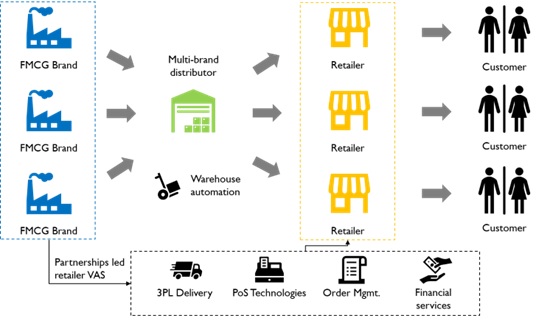
Traditional distributors are expected to consolidate to become multi-brand and multi-category distributors. Global multi-brand distribution operating models as seen in Electronics (Eg: Ingram, Redington), Automotive (Eg: Autonation, Penske) are soon to be replicated to compete successfully against online platforms. Traditional distributors with close proximity to their retailer network and local connections, will cater to local tastes with regional brands. Online players with centralized procurement function will be slow or unable to adequately capture localized customer preferences, thereby limiting their distribution dominance to National Brands and Larger Pack Sizes, similar to modern trade.

Traditional distributors should think beyond working capital management for their principal brands and offer a bouquet of customer services – convenience in order management, shorter fulfilment cycles, category aggregation for basket shopping experience, financial services, inventory management and accounting support. Partnerships with fintech, logistics tech and aggregator platforms can deliver these services at optimized cost.

Traditional distributors are also likely to backward integrate and reduce costs to pass on incremental margins to customers (Retailers). 3PL and warehousing operations for principal brands are one opportunity. Private label product introduction through contract manufacturing, leveraging the vast MSME ecosystem is another opportunity to explore. Further, this would enable Unorganised or Local brands to gain more visibility as their inability to set up penetrated distribution networks impacted retailer reach.

FMCG companies, today depend on Nielsen’s retailer surveys to determine retail market shares and consumer purchase patterns. With technological intervention in order placement and fulfilment, real time and more accurate data would be available with Online marketplaces for brand analytics. These analytical insights will allow FMCG companies to roll out customized trade promotions, reorganize sales force, their beat plans and shorten product launch cycles.

The net result in a decade’s time would be a more consolidated universe in FMCG distribution, with customers – retailers & consumers benefiting the most with a wider choice for purchase, consumption and business support.

Sources:

  1. https://entrackr.com/2022/01/udaan-revenue-shot-up-6x-to-rs-5919-cr-in-fy21/
  2. Ministry of Corporate Affairs, filings from companies
  3. Company websites and annual reports

How to address the Channel Conflicts in FMCG Distribution?

How to address the Channel Conflicts in FMCG Distribution? 602 401 qwixpertadmin

Introduction

We would remember the times when grocery lists were an ubiquitous phenomenon. The local grocer or the kirana was the recipient of these lists at the beginning of every month from households in the catchment area he served. The need to deliver these lists in person or over the phone to the grocer for pick-up or delivery later in the day is slowly starting to become a thing of the past. Grocery marketplaces, some with instantaneous delivery options (quick commerce), have offered an abundance of convenience to the Indian customer. The easiest way to shop has become via the smartphone and essentials reach home in as little a time as 10 minutes. Convenience and technology led order placement is not limited to the end user and is also an option for the grocer. B2B digital marketplaces have disrupted the traditional FMCG distribution channels. The pace of this disruption and the subsequent channel conflict it has triggered has asked more questions than FMCG companies have answers to. This article analyses the genesis of these conflicts and predicts the direction the FMCG distribution model is likely to take going forward.

E-Commerce is outpacing traditional channels in the $110Bn FMCG market

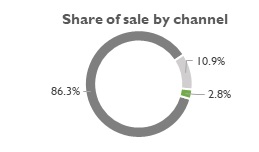
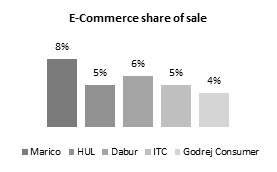
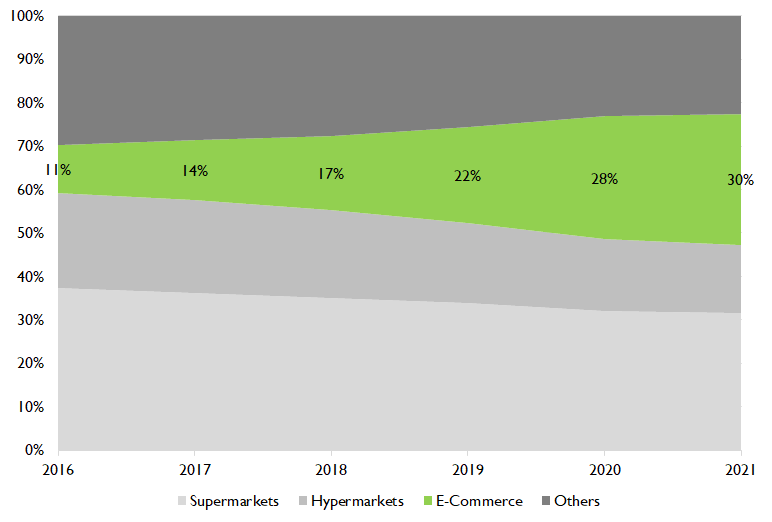
The Indian FMCG market was valued at US $110 Bn in 2020 and is expected to double by 2025 to $220 Bn. This growth is being driven by growth in rural markets, which are forecasted to beat the urban markets in consumption by 2025. FMCG retail landscape in India is dominated by traditional trade with its mom-and pop stores sells which accounts for ~86% the market (Fig 1). Digital channels including E-Commerce and D2C (Direct to Consumer) are growing much faster than the traditional channels, with Accenture estimating that top FMCG companies derive ~7 – 8% of sales from these channels. Marico’s E-Commerce business contributed ~1% in FY17 and has grown to 8% by FY21. Dabur’s E-Commerce business has tripled in saliency from ~2% in Q2 FY21 to ~6% in Q2 FY22. ITC has seen similar progress with the digital channels contributing to 7% in Q2 FY22 as against 5% in FY21 and ~2.5% in FY20. This increase is spurred by the disruption by marketplace platforms such as Big Basket, Udaan, Dunzo, Amazon Pantry, Flipkart, Jio Mart.
General Trade Modern Trade E- Commerce

Fig 1: FMCG sales split by Channel – 2020     

Fig 2: E-Com contribution in leading FMCG firms

With the ease of access to digital infrastructure, there has been a rise in the number of internet users. According to the Ministry of Electronics and Information Technology (MeitY), there were 448 Mn active social media users in India in February 2021. This in turn has influenced online shopping trends with social media being the biggest customer acquisition channel. On the other end of the shopping spectrum, lies the General or Traditional Trade.

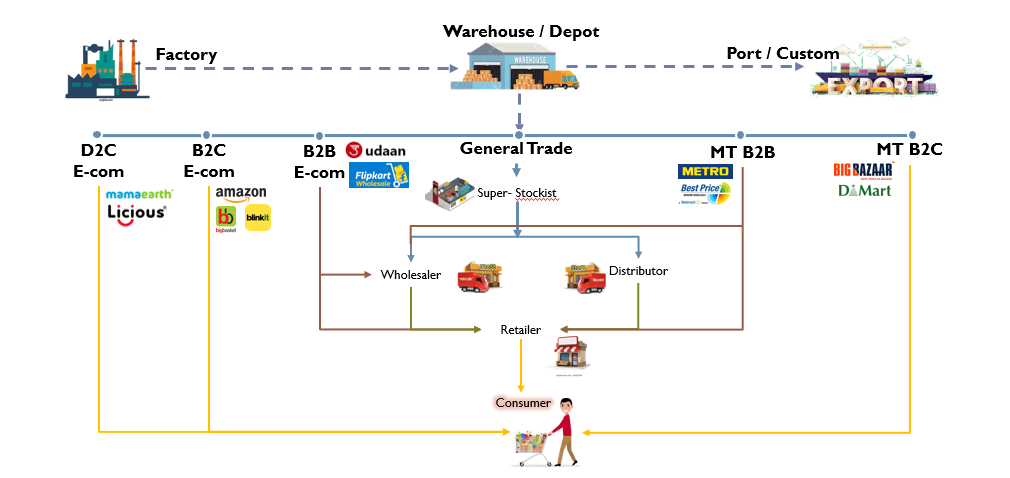
The general trade with ~13 million outlets and Modern trade with ~18,000 outlets (as per Nielsen estimates) sold FMCG products to customer. With the advent of technology, a customer today can approach alternate channels such as social media, marketplace platforms or company websites and apps for their favorite brands. Social commerce, reseller models and O2O (Online to Offline) have emerged as popular alternative channels in China and have enabled disruption across all retail categories – Food to Furniture to Fashion. The FMCG distribution model in India now has at least 7 unique channels, substantial in market size as shown in Fig 3.

Figure 3: FMCG Distribution Channels

Coverage gaps and enhanced technology penetration enabling B2B E-Commerce advent
With the advent of new channels – D2C, E-Commerce – the FMCG customer or channel partner is set to gravitate towards to online channels steadily over time. This migration is expected to be sharper in urban markets, accentuated by the COVID-19 pandemic. The Chinese Urban FMCG market has seen a near 20%+ increased contribution from E-Commerce in a mere 5 year period (Fig 4), with a growth rate of nearly 35% YoY. The Indian economy is expected to follow a similar trend, even if not at such a frenetic pace.

Fig 4. Share of retail sale by channel – China FMCG Urban market

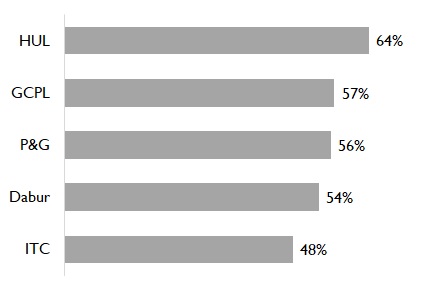
Traditional distribution channels in India contribute to 86% of the FMCG business but direct penetration of even FMCG leaders are ~60% (Fig 5). FMCG companies have coaxed, incentivized and disincentivized traditional distributions to ensure direct coverage, only for the distributors & wholesalers to successfully argue against it with the financial unviability of a direct distribution model. While a vast majority of the remaining 40%, primarily in rural geographies, get covered through indirect distribution (wholesalers, retailer -> retailer purchase), challenges remain in logistics, lower margins for channel partners and higher than MRP prices for customers.

Fig. 5. Direct Customer Penetration

These challenges have paved the way for B2B E-Commerce firms to enter, disrupt, plug coverage gaps and offer value added services to both FMCG companies & retailers. Companies like Elastic Run, Udaan, Jio Mart are being operated on this premise and are unicorns today.

Rise of channel conflict between traditional distributors and B2B e-commerce

With the emergence of B2B E-Commerce, urban markets have emerged early adopters, transferring a share of the pie from traditional distributors to these online platforms. Competition has given way to channel conflict and the FMCG firms are caught in the crosshairs. The new year of 2022 brought new challenge for major brands. In the month of January, distributors in Maharastra9, went on a strike and stopped selling HUL products, followed by distributors of colgate palmolive. Dhairyashil Patil, President of The All India Consumer Product Distributors Federation10 and The Maharashtra State Consumer Product Distributors Federation (MCPDF), told Business Line that the decision was taken due to brands refusal to engage with them on their concerns regarding the lack of price parity between traditional distributors and organised B2B distributors (Jio Mart, Metro, Walmart and Udaan).

All India consumer products distributor federation11 alleged that FMCG companies were selling products at lower prices to B2B distributors and further the organized B2B distributors were selling the same products to retailers at a lower price. In response to the AICPDFs concerns, Amul and Parle have stopped direct supply to Udaan12. Other large FMCG organizations such as HUL, Marico have acknowledged the issue publicly and have promised credible steps13 to support fair returns on investment for their general trade distribution channel.

We at Qwixpert have spent time analyzing the issue in depth and also offer solutions to FMCG organizations to address channel conflict.

The E-commerce distribution model offers an attractive value proposition

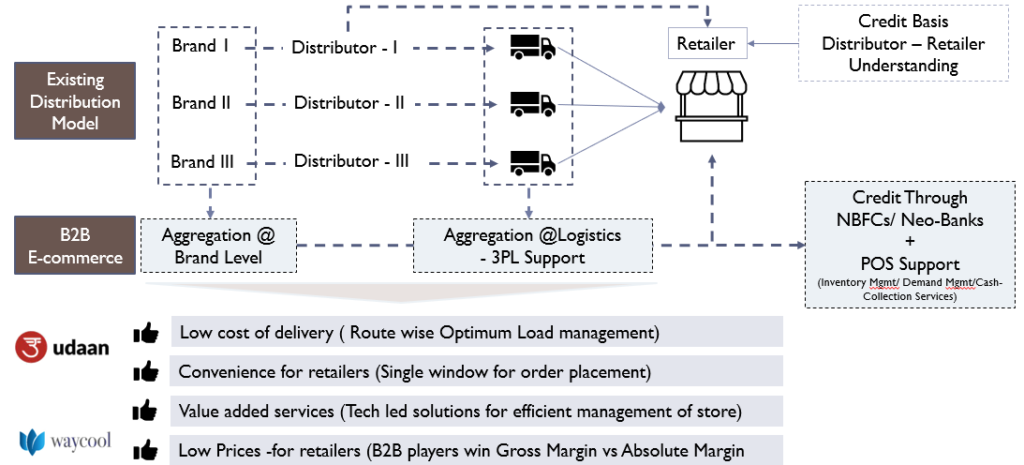
Let us start by understanding the operating model and value proposition of emerging B2B distributors such as Jio Mart, Udaan, Elastic Run and others, to both the FMCG players (suppliers) and Retailers (customers). Convenience through technology enablement, value added services and network effects of supply & demand consolidation are core principles of operation (Fig 6).


Fig 6: Value proposition – B2B E-Commerce

  1. Multicategory demand aggregation – unlike traditional distributors B2B E-commerce players are product category and brand agnostic leading to many advantages.
    • Retail & geographic demand aggregation reducing unit cost of logistics
    • Ability to pass on lower cost of operations to retailers by offering higher margins
  2. Optimized outbound logistics for FMCG brands – B2B E-Com players can in the future replace super stockists & stockists, reducing cost & complexity in downstream operations
  3. Enhanced penetration and coverage – Shared logistics across categories and retailers allow B2B E-Commerce players to viably supply rural & remote geographies
  4. Door-step delivery – No more visits to multiple wholesalers will unburden retailers
  5. Credit facility – Partnerships with financial institutions (including new age fintech firms) offer similar or better credit options to retailers in comparison to the GT distributor’s terms or those from local unorganized networks
  6. Value added services – With the use of IT based solutions, B2B e-commerce players offer full stack app-based platform to place purchase orders and other services such as billing software, stock return indents, inventory management, fintech linked cash & loan collection, automated order replenishment

B2B E-commerce business’ income streams threatens multiple business models

The value proposition, as noted above, substantially elevates the nature of competition to traditional distribution channels. This coupled with the potential to derive income from several new income streams can alter the very foundation of FMCG distribution in India.

Control over the demand data allows B2B E-commerce players to offer Private Label products, especially in categories with lower brand loyalty. This will adversely affect revenues of FMCG brands. Partnership fees with various service providers who digitize general trade operations – accounting, financial services, inventory & demand management. Some companies have even launched their own fintech arms. The digital platform and marketplace business model offers monetization opportunities – digital marketing – search & display ads, brand promotions, charges on fulfilment services, listing & discovery fees, sale of demand data post analytics to brands.

These income streams disrupt multiple industries and functions – Asset light approach to retail sale data will impact retail research agencies like Nielsen and Kantar, Private Label sales opportunities will promote massive contract manufacturing opportunities for MSMEs and demand aggregation may make sales organizations leaner in traditional FMCG firms. The general trade distribution model also offered higher visibility over retailer sales data with sales people collecting & servicing orders. Loss of control over this data gold mine and the evidenced success of private label in global markets, have made FMCG firms circumspect.

FMCG brands can invest in assets, new partnerships & technology to address conflict

Despite general trade being the major source of distribution in India for decades, ~50 – 60% direct retail coverage creates a just cause for E-commerce businesses. The growing Indian market allows for both traditional and e-commerce channels to co-exist profitably although the status quo will have to change. FMCG brands can take several steps to resolve channel conflict and achieve inclusive growth across channels.
Channel conflict is not new to FMCG business – was seen when modern trade emerged. Most notably, consumer electronics has seen an aggressive version of this conflict with the emergence of E-Com marketplace platforms.

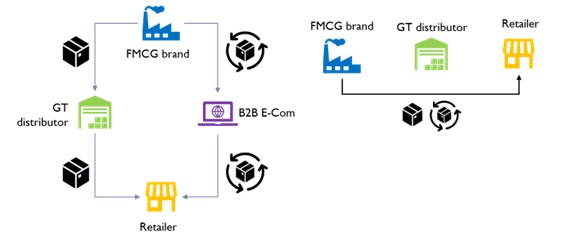
  1. Channel exclusivity among products and categories is often the preferred solution. However, this solution may not offer long term equilibrium in the current environment.
  2. FMCG firms are also experimenting with a direct to retailer delivery model, which bypasses the traditional distributor in their value chain. Thereby ensuring full visibility over demand data. Asian paints has successfully been operating this model for several years, offering higher service levels & customer satisfaction to its retailer partners. Qwixpert is engaged with a leading FMCG brand in evaluating this distribution model.
  3. Direct to retailer distribution model also needs a relook at warehouse networks – locationally, structurally and operationally. Investment in technology, Automated Storage & Retrieval Systems, Robotic picking, conveying and sortation systems, become critical to manage higher order complexity & throughput.
  4. Co-opetition (Collaborate competition) among brands are critical to support traditional distributors. Demand aggregation among FMCG brands in non-competing categories by offering multi-brand distribution will improve General Trade distributor RoI. Co-opetition is not new to the distribution business environment. Automotive (Eg: Autonation, Penske) and consumer electronics (Eg: Redington, Ingram) players have long followed this in the west. Best practices from these models can be identified and emulated.
  5. Technology enablement of General Trade Distributors is another solution. Leveraging 3rd part services from logistics (eg: Delhivery, Shadowfax) to facilitate last mile delivery with synergies in demand aggregation, Point of Sale technology solutions (payment gateways, order management, fulfilment, accounting & GST filing) and fintech partnerships for easy credit can ease the burden on distributors both operationally and financially. Working capital locked up can be freed and profit margins become higher.

Fig 7: Channel exclusivity and Direct to Retailer distribution

Fig 8: Multi-brand General Trade distribution system with Competitive services

Conclusion
Technology adoption in the country is rising at a frenetic pace. With the emergence of B2B marketplaces, traditional processes have been disrupted and the ensuing channel conflict is now unavoidable. The future state of equilibrium will iron out inefficiencies but must ensure an equal competitive platform for traditional and online marketplace channels. A win-win scenario does exist but it is not a quick fix. The higher degree of convenience and lower cost of service will gravitate retailers towards to B2B E-Commerce companies unless the FMCG brands and distributors equip themselves adequately.

The traditional channel of distribution must undergo massive changes in its operating model to remain competitive. FMCG companies must invest in distributor operating model upgrades. Partnerships with fintech, logistics and point of sale technologies will equip general trade distributors to compete with online channels and also reduce their costs and working capital pressures. Consolidation of general trade distribution similar to global models in automotive and electronics industries is expected.

– Giridharan Raghunathan and Ayushi Barnwal

Sources:
1. https://www.ibef.org/download/FMCG-September-2021.pdf
2. https://www.livemint.com/industry/retail/ecommerce-emerging-as-bigger-retail-channel-11623690512609.html
3. https://marico.com/investorspdf/Marico_-_Harnessing_Digital_-_Arisaig_Partners_Consumer_Symposium_2017_-_September_17.pdf
4. https://www.livemint.com/companies/news/heres-how-much-e-commerce-is-contributing-to-sales-of-large-fmcg-companies-11626611943905.html
5. https://www.businesstoday.in/latest/corporate/story/dabur-india-q2-profit-rises-20-to-rs-482-crore-e-commerce-biz-grows-over-200-277548-2020-11-03
6. https://www.business-standard.com/article/companies/itc-doesn-t-rule-out-listing-infotech-biz-open-to-creating-value-for-fmcg-121121401480_1.html
7. https://www.livemint.com/industry/retail/itcs-fmcg-sales-via-e-commerce-doubled-in-fy21-11626348915830.html
8. https://www.bain.com/insights/a-sudden-slowdown-in-2021-fmcg-recovery/
9. https://www.thehindubusinessline.com/companies/now-distributors-to-block-hul-colgate-products-in-4-more-states/article38094485.ece
10. https://www.thehindubusinessline.com/companies/after-hul-maharashtra-distributors-to-stop-selling-products-of-other-fmcgs/article38081998.ece
11. https://www.livemint.com/industry/retail/fmcg-distributors-seek-level-playing-field-threaten-firms-of-noncooperation-11638771763050.html
12. https://economictimes.indiatimes.com/tech/startups/amul-parle-others-stop-direct-supply-to-b2b-startup-udaan/articleshow/85964942.cms
13. https://www.thehindubusinessline.com/companies/after-hul-maharashtra-distributors-to-stop-selling-products-of-other-fmcgs/article38081998.ece