



When the Numbers Don’t Add Up
Picture this: A mid-sized Pune-based FMCG company manufacturing a popular range of packaged spices and ready-to-cook masalas. Their sales team is hitting targets. Retail shelf presence is growing. The marketing team is buzzing with new campaign ideas. And yet, every quarter review ends with the CFO staring at margins that refuse to budge past 8%, while industry peers are consistently reporting 14-16%.
The team blames distributor margins, raw material inflation, GST complexity et al. However, a deeper investigation reveals the uncomfortable truth – ‘the crisis lies inside’. Conversion cost per kg is 34% higher than the nearest competitor, Overall Equipment Effectiveness (OEE) sits at 51% vis-à-vis leading benchmark of 75-80%, changeover times between SKUs average 4 hrs, yield loss in the blending process has been silently running at 6-7% for years, energy consumption per unit is nearly double to a comparable plant; all absorbed into a catch-all “wastage” line item that no one audits.
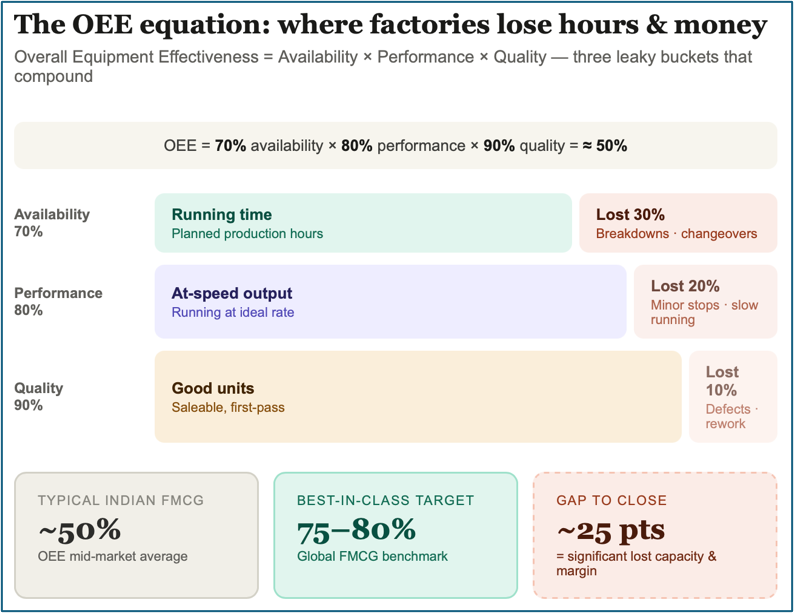
It is not a failing company but is one flying blind inside its own factory – and paying dearly for it. This story is not unique. Across India’s FMCG landscape, hundreds of companies, from regional players to large multi-plant enterprises, carry significant hidden cost burdens within their manufacturing operations, simply because factory cost economics has never been treated as a strategic discipline.
How Companies Traditionally Managed Factory Costs
For most of India’s FMCG history – particularly from the liberalisation era through the 2010s – factory cost management, unlike raw material costs, was largely reactive and siloed. The dominant mindset was one of cost containment rather than cost engineering.
Finance teams tracked aggregate budget lines: raw material costs, power and fuel, labour, and overheads. Plant managers focused on throughput – keeping lines running and meeting dispatch targets. The two functions rarely spoke the same language. Finance wanted variance reports; operations wanted production numbers. The cost structure of a factory was treated as essentially fixed, punctuated by annual negotiations with vendors and occasional capital investments in capacity.
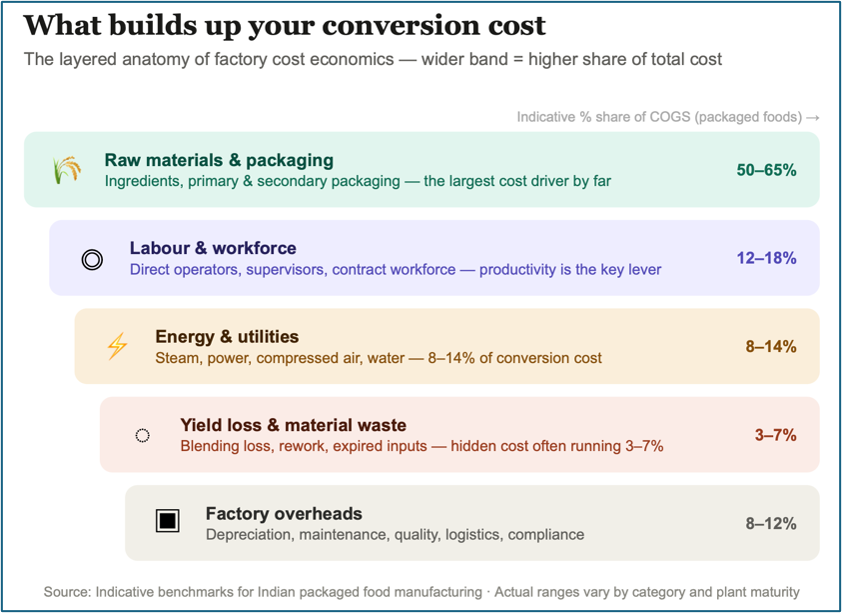
Benchmarking, where it existed, was informal – a plant head comparing notes with a peer at an industry conference, or a consultant’s rule-of-thumb target pulled from a global study with little India-specific context. Standard costing systems were implemented in ERP platforms, but often with assumptions baked in at the time of implementation that were never revisited. A company might technically “know” its standard conversion cost, while being entirely unaware that actual costs had drifted 20-25% above standard over several years.
The tolerance for this ambiguity was enabled by a forgiving macro environment. Rural consumption was growing steadily. Urban premiumisation was expanding category sizes. Input cost cycles, while volatile, were manageable within the pricing power that brand equity afforded. In short, strong top-line growth papered over manufacturing inefficiency. Margins were under pressure, but pressure that could be explained away.
What Has Changed and Why It Can No Longer Be Ignored
The operating environment for FMCG manufacturers in India has shifted structurally, and several forces are converging to make factory cost economics an existential priority rather than a nice-to-have. Manufacturers within a single FMCG company – both own and contract manufacturers – compete with each other basis the overall cost per unit.
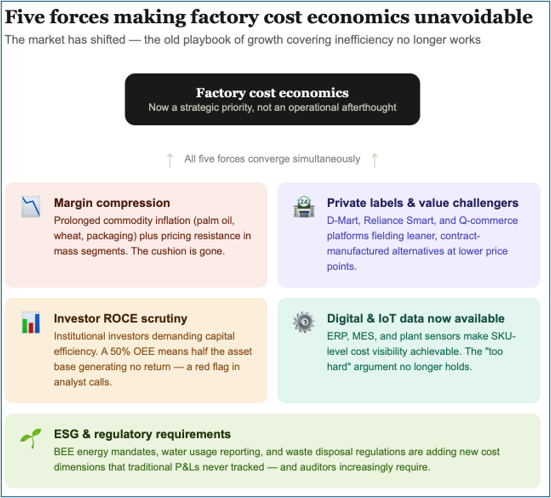
Margin compression is no longer temporary. The post-pandemic years brought a prolonged period of commodity inflation – palm oil, wheat, packaging materials, and fuel all spiked. While commodity prices have partially moderated, input cost volatility has become the new normal. At the same time, competitive intensity has made it increasingly difficult to fully pass on cost increases to consumers through price hikes, particularly in mass and semi-premium segments.
The rise of private labels and value players. Organised retail chains – Reliance Smart, D-Mart, and others – have aggressively expanded private label portfolios. Quick commerce platforms have lowered barriers to entry for challenger brands. These competitors are often leaner by design, built on contract manufacturing arrangements with tightly negotiated conversion costs. Legacy FMCG players cannot compete on price if their cost-to-serve is structurally higher.
Investor scrutiny on capital efficiency. As India’s FMCG sector matures, institutional investors are moving beyond revenue growth metrics to demand ROCE (Return on Capital Employed) improvement. Factories represent the single largest asset on most FMCG balance sheets. An OEE of 50% effectively means half the invested capital is generating no return. This is no longer a footnote – it is a red flag in analyst calls.
Digital and data infrastructure has made granularity possible. The widespread adoption of ERP systems, IoT-enabled plant sensors, and manufacturing execution systems (MES) means that the data required to understand cost at the machine, line, shift, and SKU level now exists – or can be made available at a reasonable investment. There is no longer a credible argument that factory cost visibility is too difficult to achieve. However, the challenge of getting clean data depends significantly on the maturity of the organization.
Regulatory and sustainability pressures. ESG commitments and Bureau of Energy Efficiency (BEE) mandates are pushing manufacturers to optimise energy consumption. Water usage reporting and waste disposal regulations are adding further cost dimensions that a traditional P&L never tracked rigorously.
The Key Imperatives for Driving Factory Cost Economics
Building genuine capability in factory cost economics requires action across several interconnected dimensions.
Granular cost visibility at the line and SKU level. The first imperative is simply to see clearly. Companies must move beyond plant-level cost aggregates to understand conversion cost per SKU, per line, and per shift. This requires integrating production data with financial systems – a non-trivial exercise, but a foundational one. Without this visibility, every improvement initiative is shooting in the dark.
OEE as a living management metric. Overall Equipment Effectiveness needs to be tracked in near-real-time and cascaded to the shop floor, not compiled monthly for a finance review deck. Availability losses, performance losses, and quality losses must each be addressed with distinct intervention strategies.
Zero-loss thinking in yield and waste. Every gram of raw material that does not become a saleable unit is a cost. Leading FMCG manufacturers globally deploy zero-loss frameworks to systematically identify, quantify, and eliminate yield leakage across the value chain – from intake to filling to packaging.
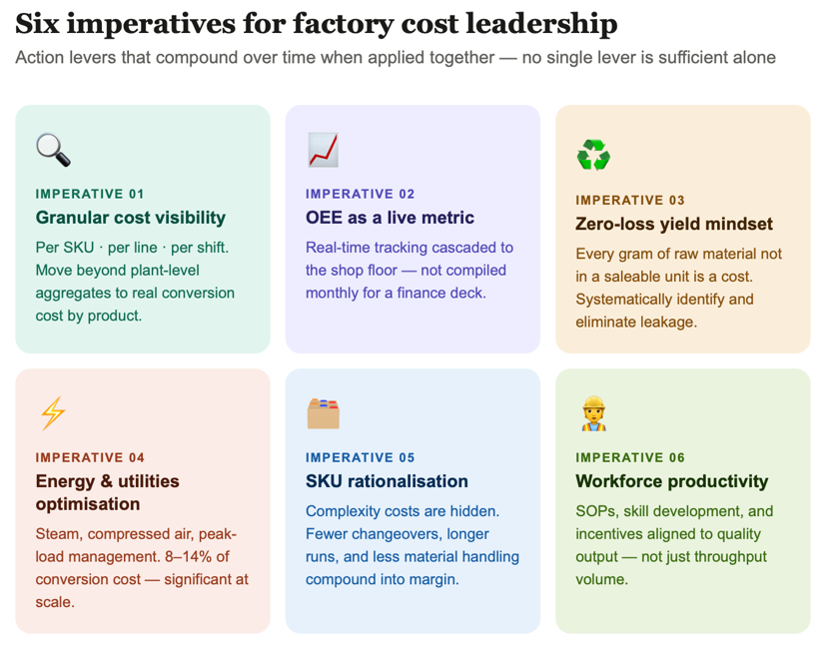
Energy and utilities management. In most food and personal care manufacturing, energy accounts for 8-14% of conversion cost. Steam optimisation, compressed air audits, lighting upgrades, and peak-load management are not glamorous, but they compound significantly at scale.
SKU rationalisation linked to manufacturing complexity. Proliferating SKU portfolios impose hidden complexity costs – more changeovers, shorter runs, higher material handling, greater scheduling friction. Factory cost economics must feed directly into portfolio strategy decisions.
Workforce productivity and capability building. Labour productivity in Indian FMCG manufacturing is highly variable. Structured skill development, standard operating procedures, and incentive alignment between output quality and operator compensation are critical levers.
The Challenges
The path is not without obstacles. The most persistent challenge is cultural – a factory culture where the cost-per-unit is “finance’s problem” and the plant team’s job is simply to produce. Breaking this silo requires sustained leadership commitment and the right incentive structures.
Data quality is a recurring issue. Even companies with ERP systems often find that production reporting is inconsistent, manual entries are error-prone, and the data required to calculate true conversion costs per SKU simply does not exist in a clean form. Building the data foundation is time-consuming and unglamorous work.
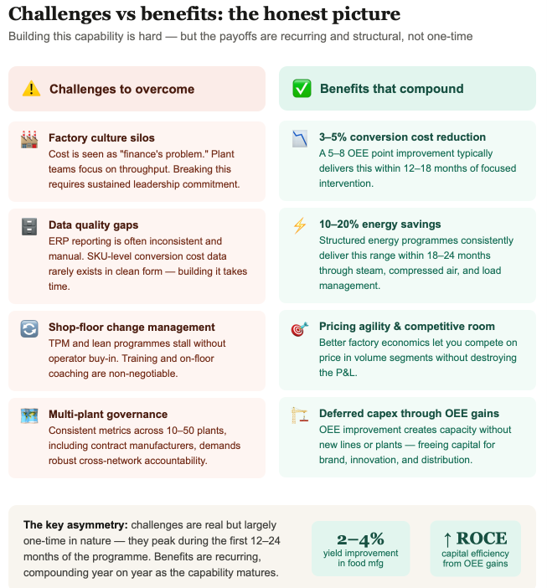
Change management at the plant level is significant. Initiatives like total productive maintenance (TPM) or lean manufacturing require genuine behavioural change from operators and supervisors, not just top-down mandates. Without adequate training and on-the-floor coaching, programmes stall after initial enthusiasm.
Multi-plant coordination is another complexity. Large FMCG companies operate networks of 10, 20, or even 50 plants, often including contract manufacturing partners. Establishing consistent metrics, standards, and accountability across this network requires robust governance. In addition, an integrated planning to establish which-SKU-to-manufacture-where-and-in-what-quantity is critical, and is nowadays driven through the best commercials offering by the manufacturing setup. Change management at the plant level is significant. Initiatives like total productive maintenance (TPM) or lean manufacturing require genuine behavioural change from operators and supervisors, not just top-down mandates. Without adequate training and on-the-floor coaching, programmes stall after initial enthusiasm.
Multi-plant coordination is another complexity. Large FMCG companies operate networks of 10, 20, or even 50 plants, often including contract manufacturing partners. Establishing consistent metrics, standards, and accountability across this network requires robust governance. In addition, an integrated planning to establish which-SKU-to-manufacture-where-and-in-what-quantity is critical, and is nowadays driven through the best commercials offering by the manufacturing setup.
The Benefits
The companies that have embedded factory cost economics as a core discipline consistently report compelling outcomes. A 5-8 percentage point improvement in OEE typically translates to a 3-5% reduction in conversion cost – material numbers at FMCG scale. Systematic yield improvement programmes have delivered 2-4% cost reductions in material-intensive categories. Energy optimisation initiatives typically yield 10-20% reduction in energy spend within 18-24 months.
Beyond the direct P&L impact, there are strategic benefits. Better factory economics enable more aggressive pricing in competitive segments without sacrificing margin. They free up capital that would otherwise be spent on premature capacity expansion. They improve agility – a plant with high OEE and short changeover times can respond faster to demand signals.
Most importantly, factory cost visibility creates the foundation for better strategic decisions – about which products to make in-house versus outsource, which plants to invest in, and how to configure a manufacturing network for the next decade of growth.
Conclusion
India’s FMCG sector stands at an inflection point. The era of growth covering up manufacturing inefficiency is ending. As competition intensifies (external and internal), margins tighten, and investors demand capital efficiency, the factory floor is no longer a back-office concern – it is a strategic battleground. Companies that develop genuine capability in factory cost economics will earn structural cost advantages that compound over time, enabling them to invest in brand, innovation, and distribution from a position of strength. Those that continue to fly blind, risk finding themselves permanently disadvantaged – not because of strategy, not because of brands, but because of costs they never thought to measure. The good news is that the tools, data, and methodologies to build this capability are available today. The question is simply whether the organisation has the will to look.